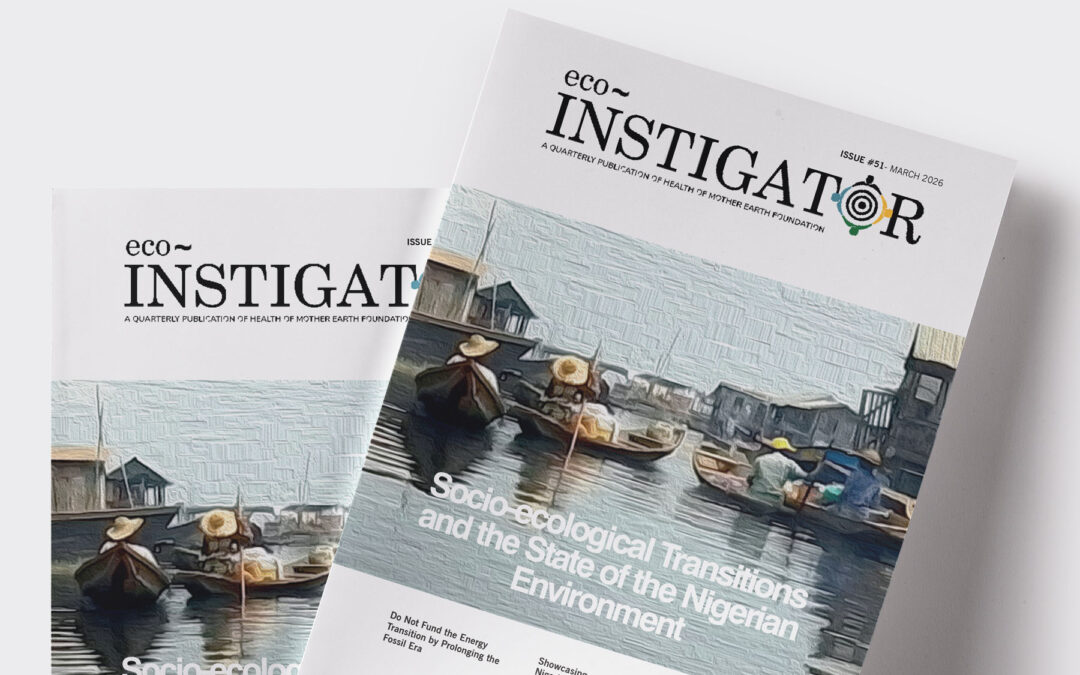
We welcome this edition of the Eco-Instigator with a deepened sense of urgency and an unshaken commitment to ecological justice.
This edition comes at a time when the fractures in our socio-ecological systems are no longer subtle but have become more visible in forced evictions of Indigenous communities by corporate and governmental bodies, disturbing degrees of environmental degradations, strained livelihoods, and in the ever-widening gap between policy promises and lived realities.
Despite these, this is also a season of renewed solidarity, sharpened analysis, and strengthened resolve within our movement. The articles in this edition bring together accounts of these tensions and contradictions, while also showing pathways of resistance, community resilience, and collective action towards more just ecological futures.
The months behind us have laid bare the deep fractures in our socio-ecological systems, but they have also revealed the power of collective action and reflection.
A key feature in this edition is our reflection on Makoko, an underserved fishing community in Lagos, Nigeria, which is currently under the hammer as the community is being demolished. The demolitions in Makoko stand as one of the most painful reminders of how “development” devoid of justice and participation can displace lives and dignity. Our visit to the community was an act of listening to and solidarity with them. Makoko reinforces a truth we hold firmly: communities must not be excluded from decisions that shape their futures.
Internally, our HOMEF team-building retreat sharpened our focus on socio-ecological transitions, examining how economic instability, energy reforms, climate pressures, and governance gaps combine to shape environmental outcomes.
The retreat provided us with an opportunity to reaffirm that transition must be just, people-centred, and grounded in community sovereignty, evidenced in the ethos of EtiUwem, anti-colonialism, responsible governance, collective action, and community resilience and participation.
This edition also reports the outcomes of our Agroecology projects, which were an opportunity to strengthen our agroecological vision: bringing together farmers, youth, and allies to champion food sovereignty, engender resistance and demonstrate that sustainable alternatives are already being practised among the people.
This edition also draws attention to the wider political, economic and social structures that sustain today’s socio-ecological crises, particularly the violence of extractivism, the persistence of pollution, and the false promises of transitions that leave old injustices intact. Across its reports, articles, poems, and conversations, the edition reflects on dispossession, food sovereignty, democratic accountability, and the role of culture, memory, youth organising, and political education in resisting systems of harm. It presents ecological justice not simply as an environmental demand, but as a broader struggle over power, participation, dignity, agency and the futures communities are entitled to shape.
Across all programmes from youth organising to culture and advocacy, we continue to confront structural injustices while nurturing imagination, solidarity and environmental justice.
This edition captures journeys of struggles and renewal. We invite you to read, reflect, and contribute. The Eco-Instigator remains a shared space for truth-telling and transformation.
The movement grows because you are part of it.
It’s always a delight to hear and read from you. We never stop looking forward to receiving your feedback, stories, articles, poems, or photos.
Continue to share with us at [email protected].
Until Victory!
You can download and read the latest issue here