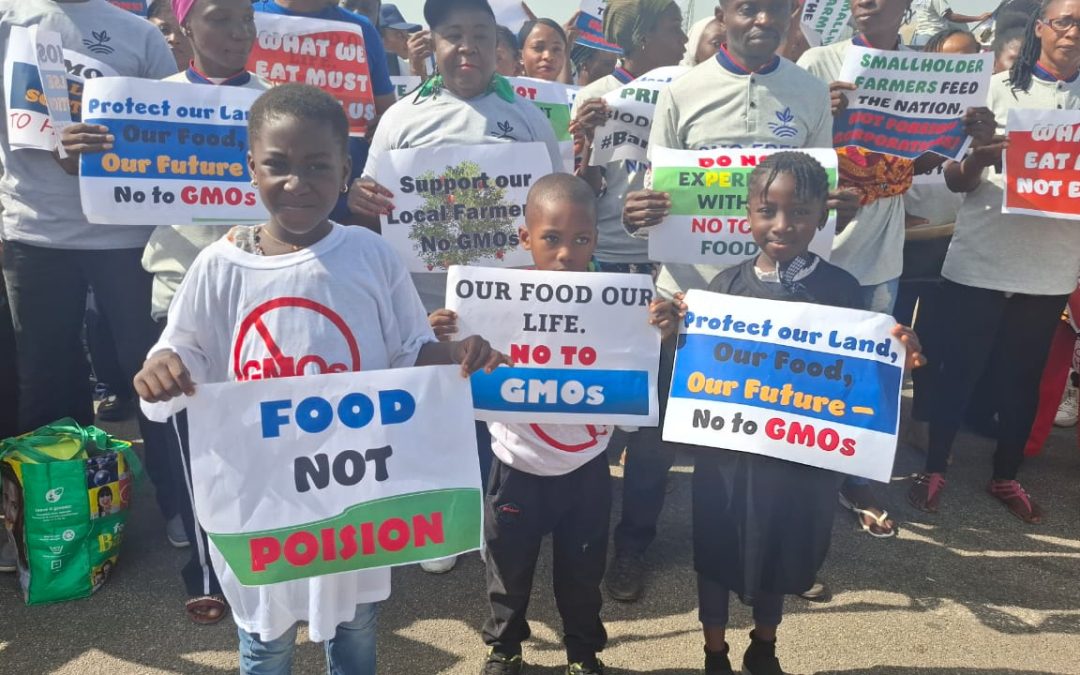
A coalition of farmers, scientists/researchers, nutritionists, legal practitioners, medical practitioners, civil society organisations, women and youth groups, etc., representing millions of Nigerian people, has called on the Government to effect a ban on GMOs, following the 2024 recommendation by the House of Representatives.
This call was made in a national rally for food sovereignty and environmental justice organised by Health of Mother Earth Foundation (HOMEF) and GMO Free Nigeria on 16th December 2025 in Abuja. The rally emphasised the need for concrete action on the 2024 recommendation of the Nigerian House of Representatives, for the suspension of GMOs pending a comprehensive investigation into the approval processes and regulatory framework governing GMOs in the country.
Participants at the rally who also submitted a petition to the House of Representatives insisted that the continued deployment and commercialisation of GMOs in Nigeria pose grave risks to food sovereignty, biodiversity, farmers’ livelihoods, public health, and environmental health.
The subject of GMOs – genetically modified organisms/foods – has been of serious concern for individuals, public health scientists, nutritionists, faith practitioners, civil society organisations and other groups for years since the set up of the National Biosafety management Agency and the first permits issued to Monsanto Nigeria Limited and the National Biotechnology Development Agency, now National Biotechnology Research and Development Agency. The resistance by the Nigerian people against GMOs intensified in 2024 with the announcement of the approval of the genetically modified TELA Maize.
According to the Executive Director of HOMEF, who was represented by Joyce Brown, Director of Programmes, “key concerns with regard to GMOs that we cannot afford to overlook include the contamination and loss of Nigeria’s genetic resources/diversity due to cross pollination from the genetically engineered crops; soil degradation resulting from transfer of toxins from GMOs such as the Bt Cowpea and Cotton (produced by the introduction of the CRY1Ab toxins for the bacterium Bacillus thuringiensis), loss of food sovereignty as the corporations control the seeds and farmers have to buy seeds season after season-negating the age long Nigerian/African culture of saving and sharing seeds.
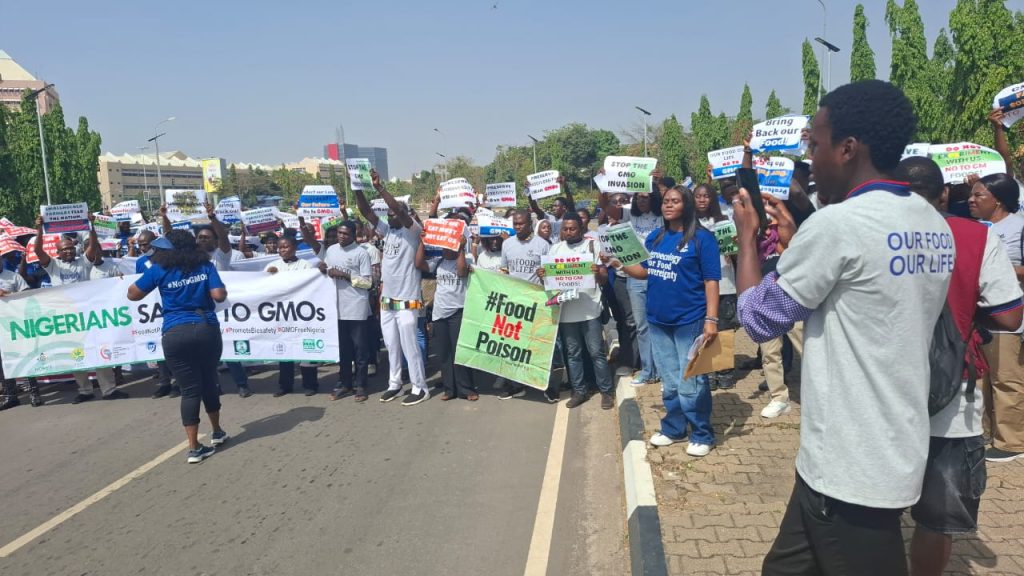
Mariann Bassey-Olsson, Deputy Director at Environmental Rights Action/Friends of the Earth, Nigeria, noted that the stark resistance to GMOs is not peculiar to Nigeria or Nigerians, as over 30 countries of the world have banned GMOs. In the European Union, countries like France, Germany, Austria, Greece, Hungary, the Netherlands, Latvia, Lithuania, Luxembourg, Bulgaria, Poland, Denmark, Malta, Slovenia, Italy, and Croatia have banned GMOs. Switzerland and Russia also have bans on GMOs. In Asia-Pacific, Australia, Turkey, Kyrgyzstan, Bhutan, Japan, and Saudi Arabia. In the Americas, Belize, Ecuador, Mexico, Peru, and Venezuela have banned GMOs. In Africa, countries like Algeria, Madagascar, and Zimbabwe have banned both the import and cultivation of GMOs. In 2024, Mexico placed an indefinite ban on genetically engineered corn. The courts said from the evidence before it, genetically engineered corn posed “the risk of imminent harm to the environment.” Mrs Olsson further explained.
Also speaking at the rally, the Country Director at Bio-integrity and Natural Food Awareness Initiative, Dr Jacqueline Ikeotuonye, debunked the argument that GMOs help to enhance yields. She noted that the yields from GMOs are not substantially more than those of conventional varieties, citing the report by the National Cotton Association of Nigeria (NACOTAN) in 2024 where the the farmers did not record any significant increase in their yields compared to the local seed varieties but observed that in three years of planting the GM variety, yield per hectare remained almost the same. NACOTAN also reported that no other plant has been able to germinate on the farmlands where the GM seeds were planted, even after four years.
Furthermore, Dr Ikeotuonye noted that “farmers across the country have complain that with GMOs, productivity reduces in the second planting season, meaning they cannot replant these seeds but have to continuously purchase the seeds every new season.”
Mr Martins Ogunlade, Associate Director of Climate and Environment Programme at Corporate Accountability and Public Participation Africa (CAPPA) stressed on the need for serious accountability from the regulatory agency – National Biosafety Management Agency (NBMA). He noted that to date, there is no evidence of any long-term risk assessment that has been undertaken, including clinical trials conducted before the commercial release of the GM crops so far released in Nigeria.
Other speakers at the rally cited several studies that link the consumption of GMOs to a myriad of diseases, including antibiotic resistance, adding that the commercially approved Bt Cowpea expresses an enzyme which confers resistance to antibiotics – neomycin phosphotransferase II (NPTII). They also noted that multiple animal studies show significant immune dysregulation, including upregulation of cytokines [protein molecules involved in immune responses] associated with asthma, allergy, and inflammation.
One of the women farmers at the rally, Lovelyn Ejim, stressed that decisions made by the government should be in the interest of the Nigerian people, adding that since 2013, there has been increased demand from the Nigerian people in online media and several other fora for a ban on GMOs. “ It is clear that Nigerians do not want this technology in our food, and the government’s persistent approval of GMOs means a total disregard for the rights of the people and exposes the vested interest in this technology”, she concluded.
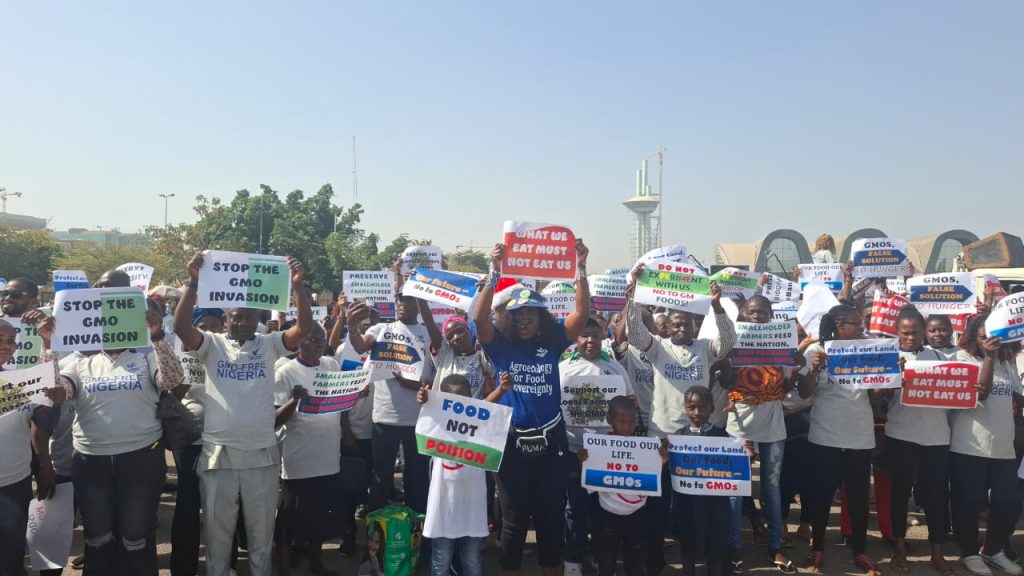
Key Demands by the rally participants include an immediate ban on all GMO materials for planting, or for food, feed production and processing in Nigeria. Participants also called for a ban on all imported processed foods containing bioengineered ingredients from our market shelves. Other key demands include a nullification of all permits so far granted as they are not backed by adequate and certified (sufficient) risk assessment; and an investment in agro-ecology, organic farming and such other food production practices/systems which assures food security and food sovereignty while strengthening the Nigerian economy.
For more information and follow up, please contact: Joyce Brown//[email protected], 08137848432
This statement is endorsed by the following organisations:
- Health of Mother Earth Foundation (HOMEF)
- GMO-Free Nigeria Alliance
- Corporate Accountability and Public Participation for Africa (CAPPA)
- Women Envoironmental Programme
- BFA Food and Health Limited
- Nigerians Against GMOs
- Environmental Rights Action/Friends of the Earth Nigeria (ERA/FoEN)
- Nigeria Women Farmers Association (NIWAAFA)
- We the People
- Association of Women Farmers of Nigeria
- Women and Youth in Agriculture
- Udama Co-operative Farm
- Green Alliance Nigeria
- Women& Children Life Advancement Initiative
- The Young Environmentalist Network (TYEN)
- Peace Point Action
- Social Action
- Committee on Vital Environmental Resources (COVER)
- Gender and Environmental Risk Reduction Initiative (GERI)
- Eco Defenders Network
- Urban-Rural Environmental Defenders (U-RED)
- Host Communities Network
- Youth and Small Holder Farmers(YOSHOFA)
- Women Environment Programme (WEP)
- Lekeh Development Foundation (LEDEF)
- Nigeria Coal Network (NCN)
- Global Prolife Alliance
- Neighborhood Environment Watch Foundation
- Socio Economic Research and Development Centre
- Community Forest Watch
- Niger Delta Development Initiative
- Kallop Humanitarian and Environmental Center
- Citizens Information and Development Initiative
- Relief International Africa
- Social Accountability and Environmental Sustainability Initiative
- Institute of Human Rights and Humanitarian Law
- Greenleaf Advocacy and Empowerment Center
- Foundation for the Conservation of the Earth
- Media Awareness and Justice Initiative
- WastePlus Environmental Services
- Visible Charity Global Foundation
- Ogoni Youths Development Initiative
- Rivers Indigenous NGOs and Civil Society Network
- Masses Interest Coalition
- Rivers Network of NGOs
- Ofure Centre for Peace and Development
- Foundation for Conservation of Nigerian Rivers
- Egbema Voice of Freedom
- Grass to Amazing Favour Global Foundation
- Rivers Community Content Initiative
- Jelu New Breed Foundation
- Rivers Civil Society Organisations
- BINEC Herbson Development Foundation
- Angel Support Foundation (ASF)
- Community Development Advocacy Foundation (CODAF)
- Egbema Voice of Freedom
- BRACED Union, Edo State Chapter
- Center for Environment, Human Rights and Development(CEHRD)
- ANPEZ Center for Environment and Development
- Society for Women and Youth Affairs (SWAYA)
- Pius Dukor Foundation for Community Development and Advancement
- Canaan Peace, Women and Community Development Initiative (CAPWOCODI)
- Kallop Humanitarian and Environmental Center
- Center for Environment, Media and Development Foundation (CEMEDEC)
- Foundation for Environmental Rights Advocacy and Development(FENRAD)
- Niger Delta Women International Resource, Environment and Development Center (NDWIRED CENTER)
- Public Enlightenment Projects (PEP)
- Greenskill Acquisition Centre Ltd
- Centre for Justice, Empowerment and Development
- Centre for Rural Emancipation, Economic and Social Development
- Child and Green Foundation
- Sunshine Progressive Youth Alliance
- Kebetkache Women Development and Resource Centre
- Rural Health and Women Development
- League of Queens International Empowerment
- Alauchi Women Development Initiative
- Media Awareness and Justice Initiative (MAJI)
- Rights advocacy & development center (RADEC)