Ogoniland’s oil crisis is often described as a historical tragedy, but it is not mere history, as oil spills continue to occur in communities across Ogoniland. Land and water remain polluted, and the impact of oil exploration and exploitation is still being felt in these communities.
More than three decades after the Ogoni Bill of Rights called for environmental protection, political inclusion, and control over Ogoni resources, many of those demands remain unresolved. Cleanup efforts have been slow and inadequate, especially given recurring spills and visible contamination. It is within this context that the Federal Government’s proposals to resume oil exploration in Ogoniland have raised serious concerns.
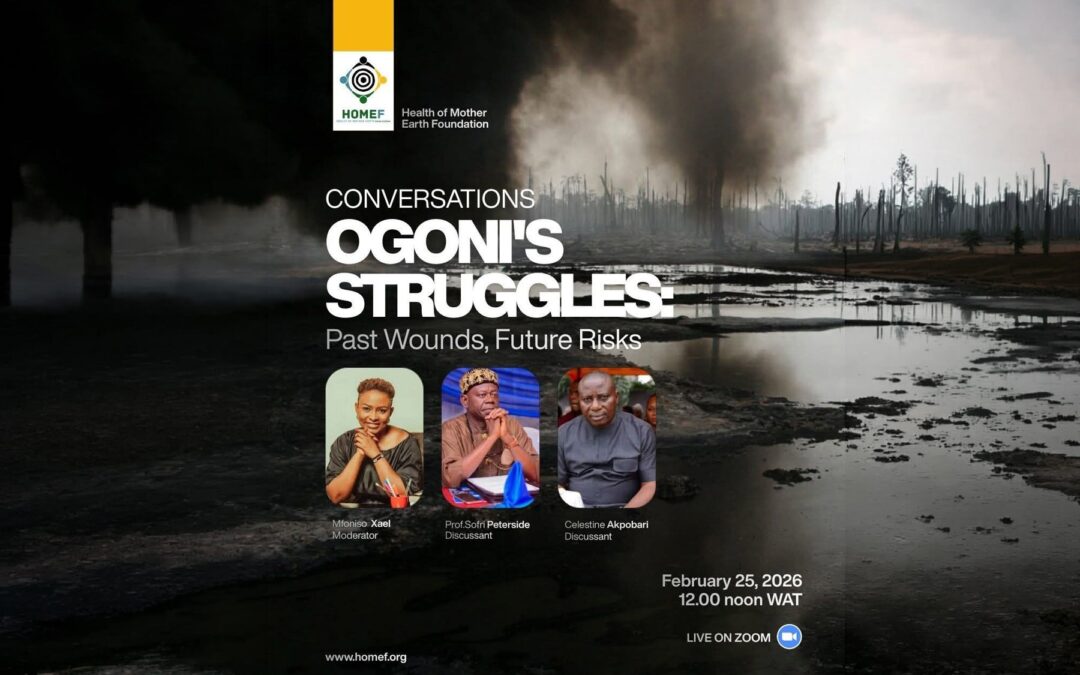
Health of Mother Earth Foundation (HOMEF), in line with its focus for the year 2026 — Social-Ecological Transition (SeT) — hosted the first session of its Conversations for the year, themed “Ogoni Struggles: Past wounds and Future Risks,” on the 25th of February 2026. The session examined the contradiction between ongoing pollution and the idea of resumption of extraction. The Conversation reflected on the history of the Ogoni struggle, the foundational demands of the Ogoni Bill of Rights, and the risks of returning to oil production without first addressing unresolved environmental damage.
The session featured Comrade Celestine Akpobari as the discussant. Celestine Akpobari is a long-standing environmental and human rights advocate from Ogoniland who has been actively involved in the struggle for environmental justice in the Niger Delta. His contributions to community mobilisation and grassroots advocacy have positioned him as a consistent voice on issues of oil pollution, accountability, and resource justice in Ogoni.
During the interactive session, the Moderator, Mfoniso Xael, Project Lead on Ikike Desk at HOMEF, engaged the discussant in talks about the future of the Ogoni struggle and the role of the younger generation. In response to a question about how young people can be mobilised to resist attempts to resume oil exploration, Comrade Akpobari emphasised the need to “remove the oxygen” that fuels political manipulation within the struggle. He explained that divisions within the community often serve political interests and weaken collective resistance.
He stressed the importance of sensitisation and political education, noting that young people must be able to recognise when they are being used to advance interests that do not serve the broader Ogoni population. According to him, awareness and consciousness are essential to strengthening the movement.
He also called for courage and accountability, stating that individuals who compromise the collective interest should be openly identified. In his words, it is important to “name and shame,” as silence enables injustice.
When asked about the kind of leadership required at this time to unite the Ogoni people and build the necessary resistance, he highlighted the need for individuals willing to sacrifice their time and resources for the collective good. He referenced the era of Ken Saro-Wiwa, noting that during that period, those undermining the struggle were openly confronted. While acknowledging that the present context is different, he emphasised that integrity and character must remain central.
In response to a further question on what younger activists can contribute at this moment, Comrade Akpobari stated that nothing is impossible if actions are genuinely rooted in public interest. He reiterated that integrity must form the foundation of any renewed movement and that the Ogoni people must resist the weaponisation of poverty, a tactic he alluded to that government and corporations are using alongside divide and rule to destabilise the people in a bid to gain access to restart oil exploration in the land. In closing, Comrade Akpobari emphatically said that a return to oil exploration in Ogoniland would mean taking their land back to ground zero, especially in a time when the world is making an effort to transition from fossil fuels and that if that is ever allowed to happen, the sacrifice of heroes like Ken Saro-Wiwa would have been for nothing.
The session concluded with the soft launch of the desktop research report titled Endless Spills: Risks of Resuming Oil Exploration in Ogoniland. The report documents recent oil spills in Ogoni communities and examines the risks and contradictions of resuming oil exploration while pollution persists and remediation remains incomplete. The research provided evidence of spill recurrence and gaps in cleanup efforts, grounding the discussion in documented realities.
The Conversation session, which had in attendance members of Civil Society groups, Journalists and other concerned individuals, ended with a shared understanding that the Ogoni struggle remains ongoing. If environmental harm continues and justice is incomplete, proposals to resume oil exploration in Ogoni land would be unfair and illogical.